Engaged Experts: AI Emboldens Faculty, Staff and Students
Lindner faculty and staff are leaders in innovation, bringing their expertise to students through inventive classroom exercises and breakthrough research.
As an R1 institution, UC is dedicated to the cultivation of knowledge through ground-breaking research. In 2024, UC achieved more than $377 million in research funding and received more than 1,200 research awards. Research continues to be conducted at the cutting edge of industry, closely aligned with the trends and needs of the professional ecosystem.
Lindner proudly contributes to this robust body of work with more than 160 meaningful research contributions during the 2024-25 academic year. We are consistently ranked as a Top 100 business school for research by Poets&Quants. In addition, our faculty and staff routinely flex their expertise for local and national media, with nearly 40 media appearances in 2024-25 covering topics such as taxes, retail, real estate, supply chain and AI.
Through our commitment to research and innovation, we prepare our students to be business problem solvers.
Lindner Research: By the Numbers
64 faculty publications
- 56 research publications*
- 6 book chapters
- 2 essays/reviews
6 books published
- 4 textbooks
- 2 scholarly books
91 faculty presentations and conference proceedings
8 faculty with more than 10,000 Google Scholar citations**
Notes: *Includes published and in-press publications. **Includes active and emeriti faculty. All information is based on data collected from May 1, 2024, through April 30, 2025
Your AI Course Schedule
Lindner is at the forefront of providing valuable classroom experiences at the intersection of multiple business disciplines and AI. From information systems and finance to marketing and economics, Lindner’s offerings equip students with the knowledge they need to succeed in the modern workplace and to transform their future or current organizations.
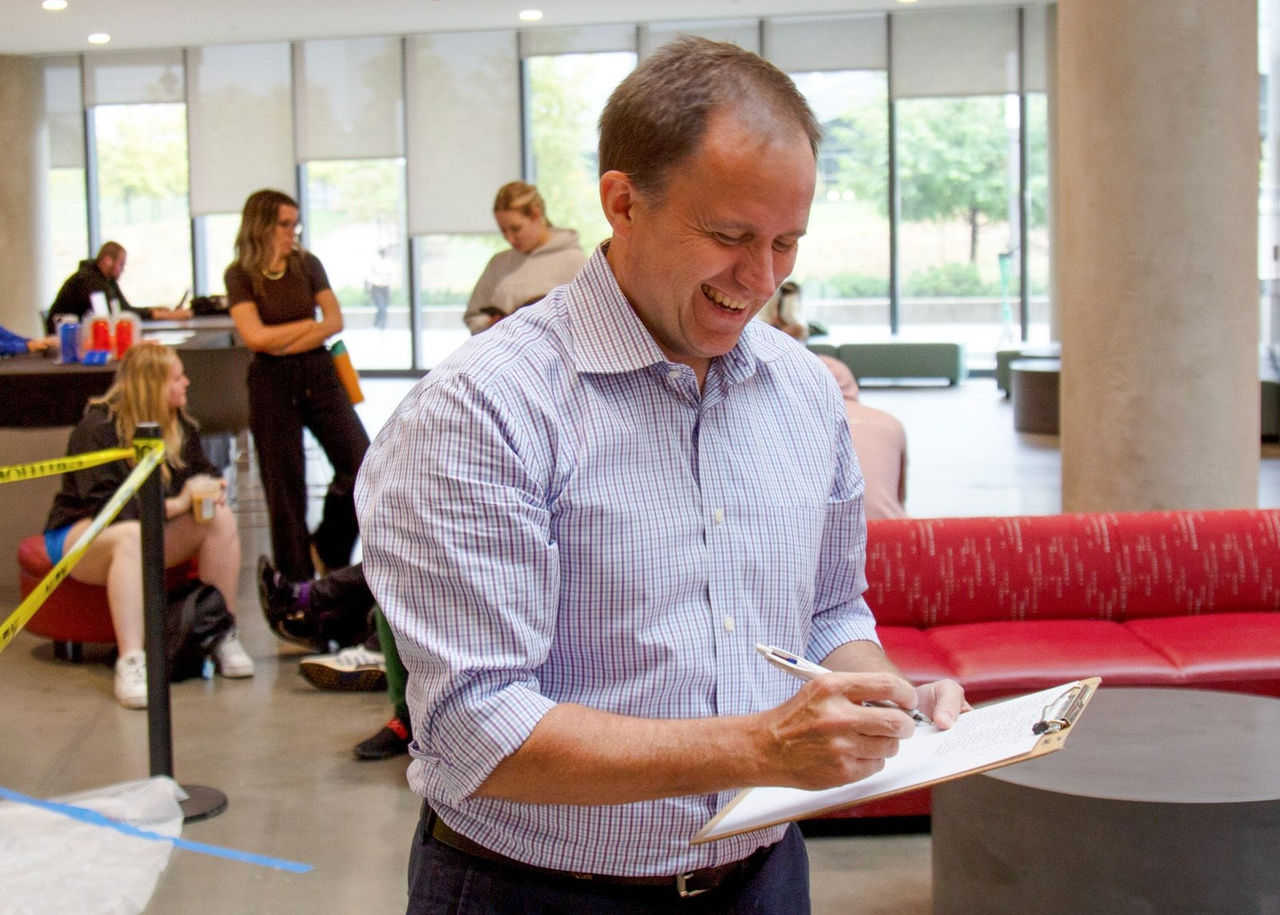
Craig Froehle, professor of operations, business analytics, and information systems, leads IS 8070 students in an exercise designed to teach them how to best collaborate with AI.
Building egg-cellent skills in AI
IS 8070: Generative AI and the Future of Work introduces Master of Business Analytics and Information Systems students to generative AI with a focus on its implications for business, the way work gets done and managerial issues. Students learn to use generative AI as a coding partner and as a creative collaborator. To practice collaborating with AI, students complete the “egg-drop project.”
Students are assigned one of two tasks: either work with a generative AI agent or chatbot to collaboratively develop a set of instructions for building a device that would protect a chicken’s egg from breaking when dropped from 30 feet, or develop the instructions solely on their own. The devices are then tested by dropping them in the Lindner Hall atrium.
The experiment reveals that students perceive instructions from student- AI collaborations to be less thorough and more enjoyable than instructions generated by students working alone — but similarly innovative and clear. Performance-wise, devices generated by students working alone are a little more successful at protecting the eggs from breaking than devices that are collaboratively developed. The assignment showcases the importance of writing quality prompts and how to extract the best possible outcomes
Making the most of $2 million (with a little help from AI)
FIN 7047: Fintech and Cryptocurrency is a course for the technology-minded graduate student studying finance. The course provides a broad overview of financial technologies including AI, blockchain, cloud computing and big data. The course's primary goal is to introduce these concepts alongside their real-world applications while creating an understanding of how cryptocurrencies function in an encrypted, decentralized environment and how investors construct crypto-based portfolios using Fintech and AI.
A major course assignment had students apply their knowledge of these technologies to a fictional $2 million crypto fund. Students were tasked with testing three separate strategies to maximize their returns. Two of the strategies represented traditional
investment strategies, whereas the third focused on a non-traditional, AI-enabled strategy. The project not only teaches students that using a range of information is critical to investment and business success, but also showcases the value of fintech and AI in making informed decisions.
Becoming purveyors of AI
More than an opportunity to teach students the ins and outs of AI tools, the goal of MKTG 7043: AI for Marketing Managers is to turn students from just users of AI into thought leaders within their own companies. This new course introduces marketing students to the continuum of AI marketing management tools available to professionals.
At the conclusion of the course, students should feel empowered to lead the exploration of AI tools for every aspect of marketing and make recommendations for such to senior management. Throughout the course, students examine applications of AI to segments such as branding, product management and strategy. The course culminates in a project that simulates a real-world presentation a professional may give to advise senior leadership on AI applications.
Recent advancements in AI, along with the rapid pace of development, make adapting AI into education and training programs a necessity.
Hamed Namavari Adjunct Instructor of Economics
Extracurriculars: Undergraduate workshops in AI
AI is not just for graduate students. Undergraduate students also receive a crash course on AI at Lindner. Adjunct Instructor of Economics Hamed Namavari runs semesterly workshops to aid students’ understanding of AI. These workshops cover a wide range of topics, including AI’s evolution, how ChatGPT works and hands-on applications in text generation, coding and AI-assisted research. Hands-on activities help build students’ AI literacy and see how these tools enhance productivity, research and problem-solving. Students exit the course with a solid grasp of AI fundamentals and the confidence to experiment with AI tools on their own.
“Recent advancements in AI, along with the rapid pace of development, make adapting AI into education and training programs a necessity. These workshops aim to equip students with the knowledge and skills to navigate this evolving landscape,” said Namavari.